
ClimateLens 2.0 is Here → See what’s new
Andy Paterson • March 3rd, 2026.

Decisions made early in the season determine every action that follows, impacting every part of the agricultural value chain. It’s not just when to plant, it’s how much fertilizer to apply, where to position inventory, and when to lock in logistics.
Increasingly, climate change is making these decisions more complex with unpredictable rainfall patterns, faster transitions from cool to warm, and unexpected frost events. This means producers make better decisions when they are more proactive in planning months ahead, based on directional seasonal forecasts, rather than reacting to day-to-day weather.
This article will show you how to make better early-season decisions and reduce risk using seasonal forecasts and how enterprise agribusinesses, like Simplot, makes better early-season decisions using ClimateAi.
This article summarizes a recent webinar we held with our customer, Simplot. You can watch the whole thing below:
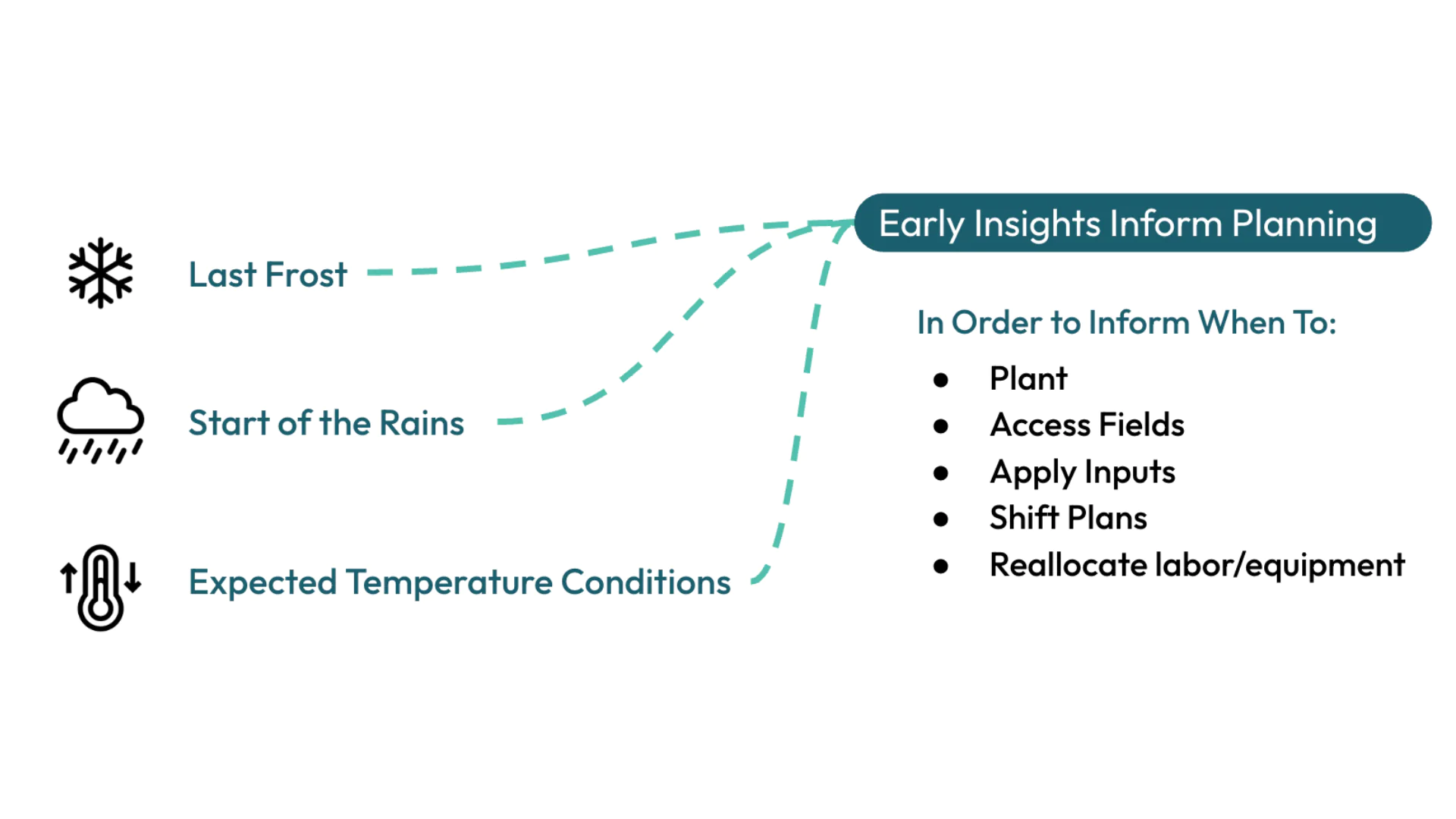
Early-season planning determines how successful the season will be, but producers often struggle to make effective, well-planned decisions. Three main issues make decision-making difficult:
Frost timing, rainfall onset, and temperature trends determine
Early-season weather has historically been difficult to make decisions around. Climate change is making those decisions much more difficult, with increasingly unpredictable rain, bigger temperature swings, and conditions that don’t match historical norms.
Decisions about planting, fertilizers, and logistics have to be made well in advance. These early decisions typically determine a crop’s profitability.
As our customer Matt Christopherson, Senior Commodity Manager at Simplot, explained in the webinar:
“We can’t wait until the last minute. We’re constantly looking at what demand will be and what we need to supply.”
For Simplot, one of those key early decisions that can’t be made last minute is managing over $300 million in annual fertilizer procurement. Good fertilizer procurement decision-making before the season starts helps Simplot optimize profitability by limiting excess fertilizer costs and runoff, and ensuring optimal plant growth.
No two years are ever the same for growers. But one decision trap they often fall into is basing decisions on the previous year.
Overcorrecting for the previous season (buying more fertilizer, planting later) can create new risks. Without forward-looking, accurate seasonal data, teams will default to their historical experience and gut feeling.
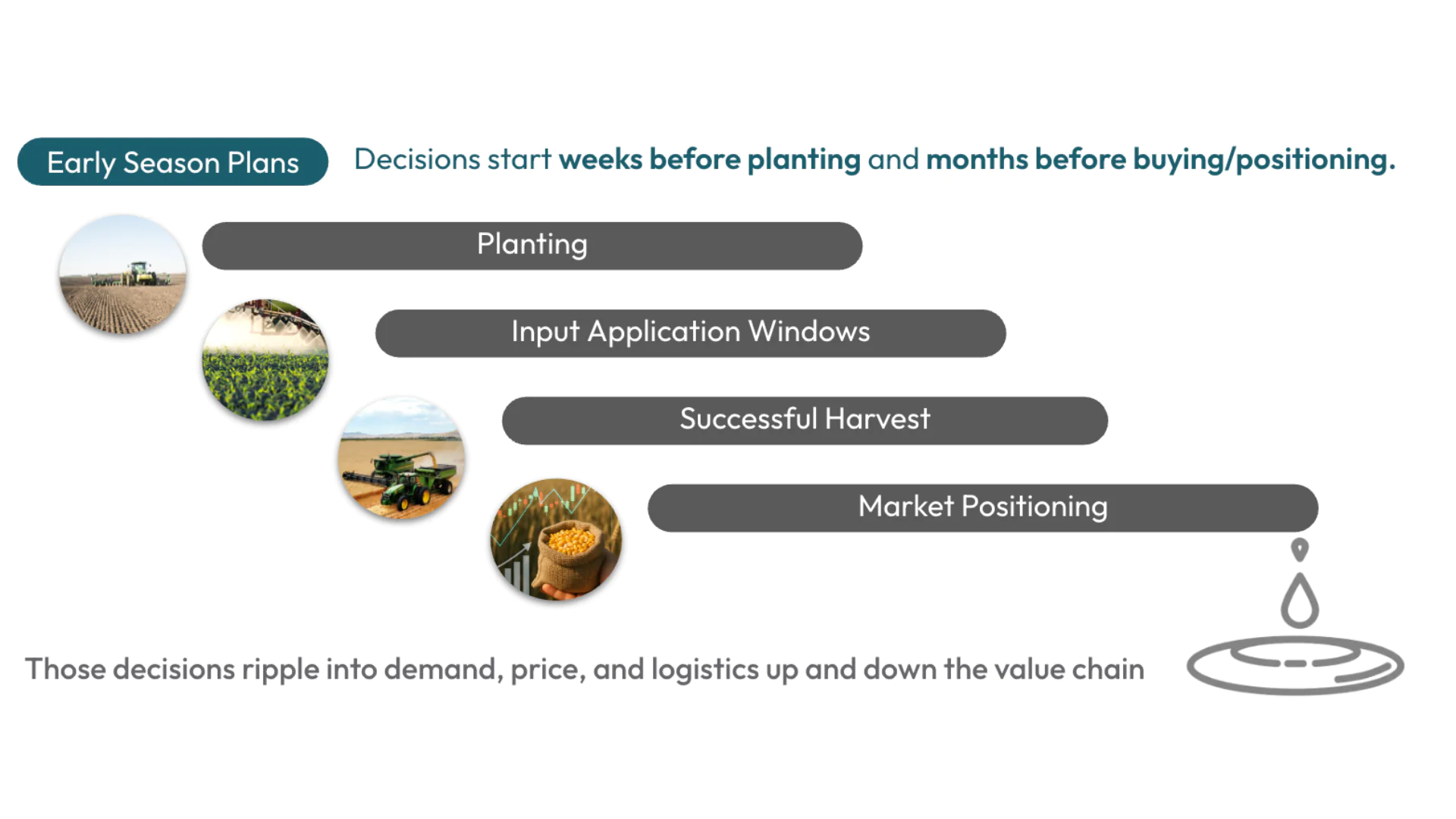
To mitigate these tough decisions, seasonal forecasts provide producers with a directional season-long signal that they can use to determine:
This allows decision-makers to move from reactive day-to-day decision-making to structured adaptive planning.
The value in these forecasts is not in adapting every decision on the fly. It’s in improving 10–20% of critical decisions. The ones that mean executing large purchases when costs are favorable, positioning inventory across regions, and planning for specific plant risks. Even these small improvements to the decision-making process can amount to tens of millions of dollars.
Weather used to be a variable based on experience. With different stakeholders using their own feelings, basing decisions on different weather providers’ forecasts, and interpreting signals differently.
By introducing a shared seasonal outlook, teams gain a common reference point based on varying confidence levels. Enabling more adaptive decision-making and cross-stakeholder alignment.
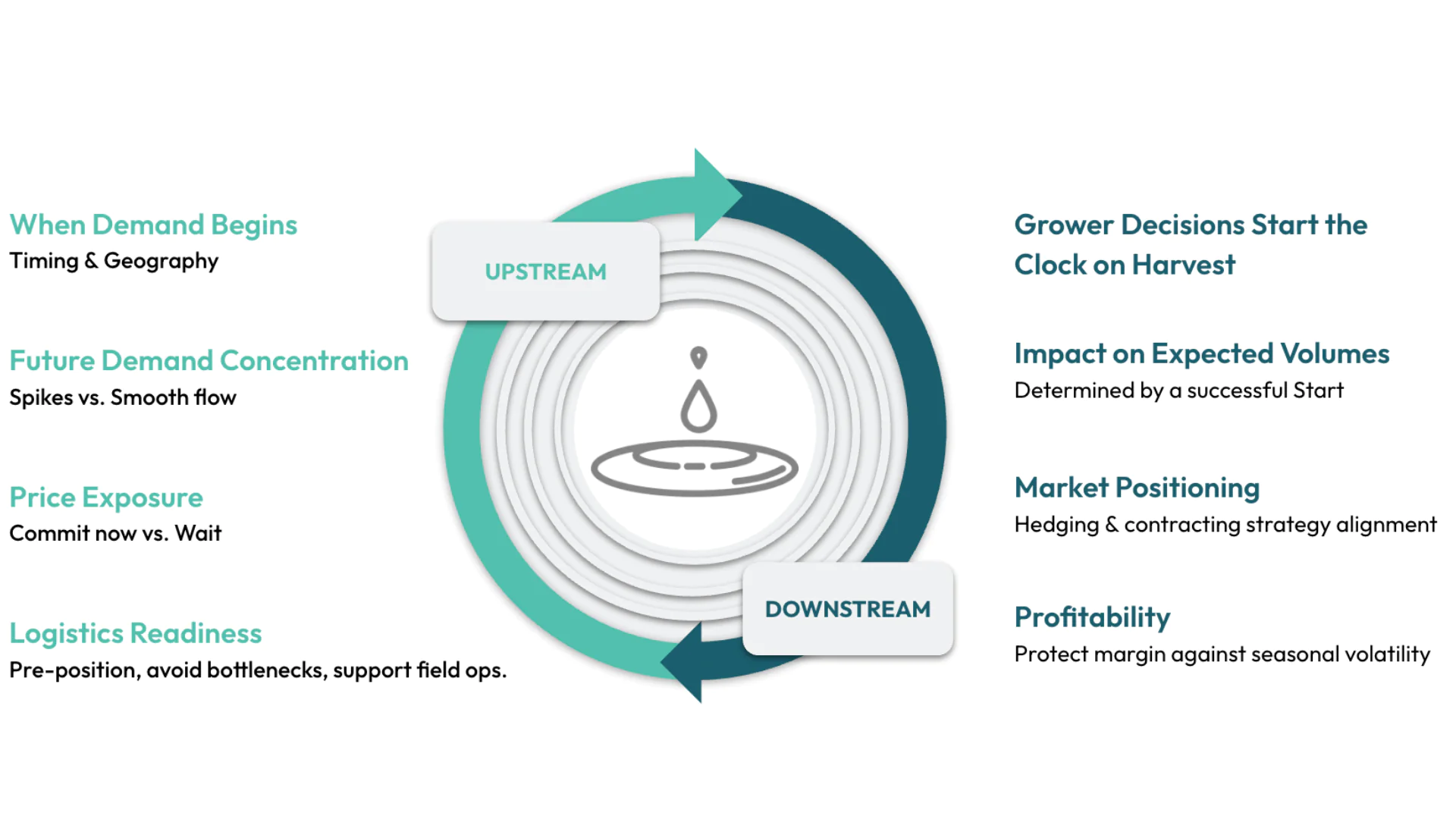
Grower decisions start the clock on harvest, influencing demand, price exposure, and profitability across the value chain.
Early-season decisions ripple across every stage of the plant life cycle and upstream and downstream in the value chain.
On the upstream side, early-season decision-making determines:
Early-season decisions impact the downstream value chain, determining:
While ClimateAi’s seasonal outlook won’t provide day-to-day precision, we do provide directional signals, which can be the difference in your early-season planning.
The three mistakes we see companies making in their early-season planning include:
To mitigate these mistakes from happening and ensure successful early-season planning, ClimateAi works with our clients through our platform to:
Early planning decisions don’t need to be set in stone either. Teams should reassess assumptions as the season evolves.
For businesses, like Simplot, spending multiple hundreds of millions on inputs, or are facing increasingly unpredictable early-season decisions. A decision that helps you get a 10-20% margin on an expanded growing season, reduced fertilizer costs, or well-timed market deployment can be your alpha for that season.
Early season decisions include planting timing, input application planning, procurement, inventory positioning, and market strategy decisions made before planting begins.
They provide directional insight into temperature and precipitation trends, helping reduce uncertainty and improve procurement and logistics decisions.
Prevented planting occurs when excessive rainfall prevents planting, significantly impacting input demand and downstream supply expectations.
Enterprise-level procurement and logistics decisions often begin months before planting to ensure product availability and manage capital exposure.

Andy Paterson is a content creator and strategist at ClimateAi. Before joining the team, he was a content leader at various climate and sustainability start-ups and enterprises.
Andy has held writing, content strategy, and editing roles at BCG, Persefoni, and Good.Lab. He has helped build one of the industry’s most popular newsletters and regularly publishes environmental science articles with Research Publishing.