
Andy Paterson • January 13th, 2026.
Companies across the agricultural value chain are increasingly dealing with unpredictable frost events. While extreme heat and drought have been in the headlines, frost damage can be just as impactful on crop yields and qualities.
Unpredictable late-season frosts are making it harder to determine when to plant, and producers are harvesting before plants reach full maturity to avoid the first frost of the season. These issues compound when producers can’t trust their forecasts, when microclimates are not captured in regional forecasts, and when alerts are mistimed or inaccurate.
These mistakes can result in millions of dollars in losses from frost damage. However, as we will show in this article, frost damage can be managed through crop and region-specific alerts, microclimate-scale weather models, and accurate harvest and planting timing.
Climate change is likely to reduce the number of frost days on average but make them less predictable, making early alerts based on accurate forecasts critical.
Historically, producers could rely on averages of last frost dates with reasonable confidence. Today, those assumptions are breaking down.
In a warming climate, spring is arriving earlier each year. This could mean plants reach phenological stages earlier, or producers are more willing to take on frost risk and plant earlier. If they do that before the year’s last frost, they could jeopardize an entire crop.
The same unpredictability is delaying the first frost day of the year. Producers worry about when to harvest to maximize the maturity of thier crop while avoiding costly frost damage from the year’s first frost.
As one seed production manager recently told us: “It’s the surprise frost—the out-of-season frost—that causes the most harm.”
Paradoxically, under warmer weather, frost is becoming more of an issue. In Europe, for example, growing seasons now start 15-20 days earlier compared to 50 years ago. In Germany, this has increased the risk of frost damage after the start of the growing season by 200%.
Three main factors are leading to frost risks being missed and becoming yield and quality issues:
Frost damage can be among the most costly weather-related yield and quality issues producers face. Inaccurate predictions of when the first and last frosts of the year will occur can run into the millions.
The costs, like the €2 billion in damage to wine and fruit growers in France after a late frost in 2021, are borne through:
To mitigate the high costs of frost damage, leading producers are changing their approach to frost detection and management:
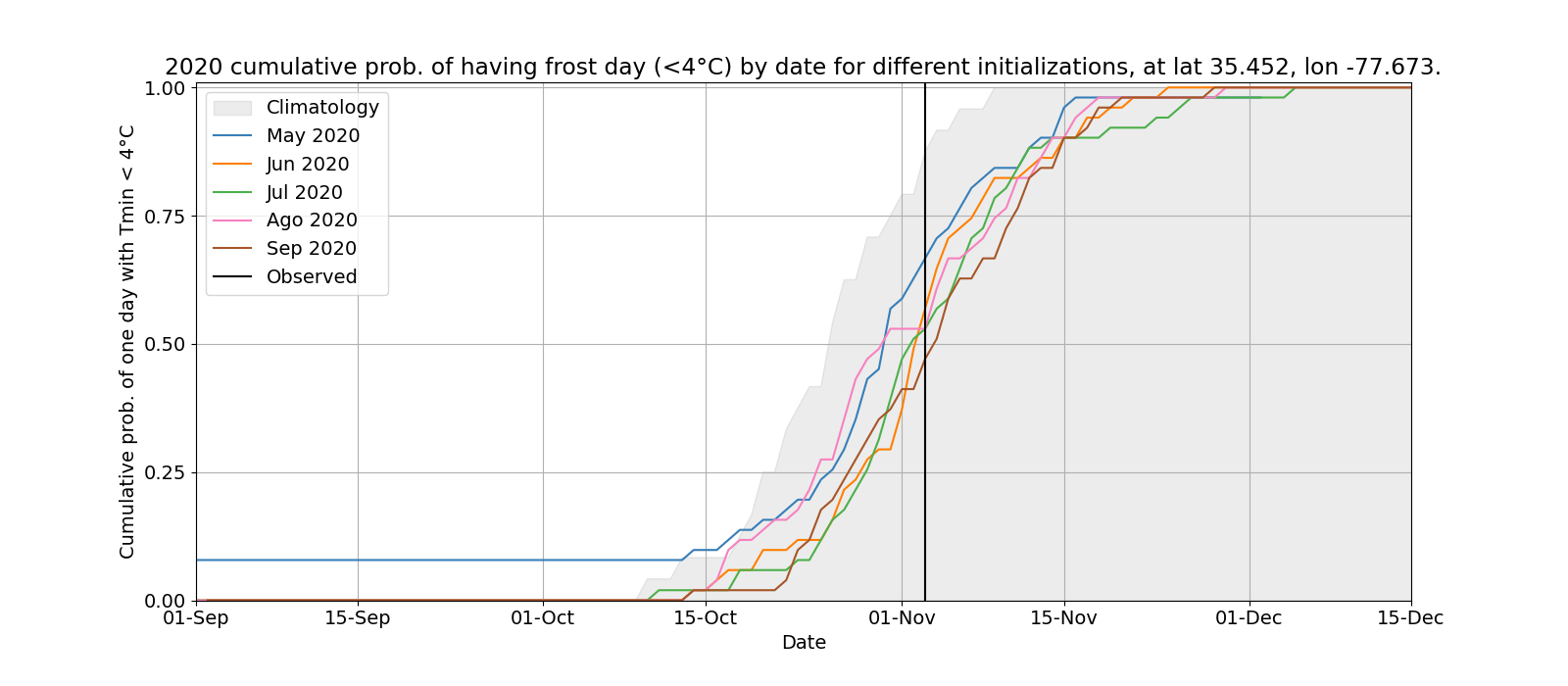
ClimateAi has a proven track record of predicting frost events much earlier and with higher confidence than traditional climatology.
Our models achieve this higher level of accuracy and lead time through three key methods:
Our forecasts use hyperlocal weather data from debiased regional station records with customer weather-station data integrated to provide a field-by-field view of frost likelihood. Using hindcasting, we have shown that these forecasts are up to 50% more accurate than standard models.
These accurate models move beyond historical data to probability-based frost outlooks that reflect real-time climate conditions. These outlooks are used to set alerts triggered when specific thresholds are met, based on crop type, phenological stage, frost duration, and confidence level. This level of accuracy can also help companies get specific parametric insurance – insurance triggered when a certain threshold is met.
Our seasonal forecasts provide accurate frost outlooks with 1-6 month lead times, enabling more strategic planning and less reactive responses throughout the season. Confidence windows across the season ensure informed harvest and planting timing decision-making.
Our Growing Degree Day (GDD) Tool then forecasts when crops will reach key growth stages, which can be overlaid with frost risk to ensure crops are harvested at their most mature before frost risk increases.
Our models downscale to 1km resolution, giving producers an accurate understanding of what is happening at the field-to-field scale and capturing topographic differences.
We also ingest customer data to correct regional models and create digital twins of each field’s microclimate.
Frost and extreme cold remain one of agriculture’s most persistent threats. But they don’t have to be one of its most costly. ClimateAi is addressing frost risk challenges through hyperlocal forecasting, crop-specific alerts, long-term climate-adaptation insights, and enabling solutions such as parametric insurance.
Producers no longer need to anxiously anticipate the first frost. Thanks to AI-driven accurate forecasts producers can plant and harvest at the optimal time, and make data-driven decisions on how to best protect their crop.
Contact ClimateAi to learn how our AI-powered platform can safeguard your crops, optimize your operations, and give you the confidence to make better decisions under increasingly unpredictable frost risks.

Andy Paterson is a content creator and strategist at ClimateAi. Before joining the team, he was a content leader at various climate and sustainability start-ups and enterprises.
Andy has held writing, content strategy, and editing roles at BCG, Persefoni, and Good.Lab. He has helped build one of the industry’s most popular newsletters and regularly publishes environmental science articles with Research Publishing.