
Andy Paterson • March 26th, 2026.
To protect soil health, reduce emissions, and prepare for a changing climate, leading food and agriculture companies are committing billions to regenerative agriculture.
Recent research shows that regenerative agriculture could be a $310 billion investment opportunity, with the potential of significant financial and ecological returns. While this makes it attractive to both farmers and companies across the agricultural value chain, most struggle to measure the ROI of their actions.
In this piece, we will show that through understanding climate risks and applying AI adaptation agents, businesses can measure the most important factor in investing in regenerative agriculture: their return.
Regenerative practices do not deliver the same results everywhere. The effectiveness of each project depends on:
For example, cover crops are used in drought-prone regions to reduce soil moisture retention and soil erosion, whereas agroforestry is used in warmer, wetter regions to protect crops from rising temperatures. However, without accurate climate projections, companies struggle to answer:
To answer these questions, adaptation agents conduct a climate risk assessment that shows what areas are most vulnerable, simulates how adaptation practices will improve resilience and reduce yield volatility, and quantifies different ROI scenarios.
Adaptation Agents make the business case for regen ag by quantifying how regenerative practices reduce climate-related yield loss.
Many companies undertake regenerative agriculture programs as pilot schemes. Often they’ll focus on working with suppliers, NGO and government partnerships, and meeting sustainability commitments.
But scaling these programs to achieve broad benefits and to shift regenerative programs from niche to the sector standard requires a clear business case.
For teams across the agricultural value chain, from farmers on the field to CFO’s at food and beverage multinationals, regenerative agriculture practices must demonstrate:
That requires quantifying how different regenerative practices perform financially under future climate scenarios.
ClimateAi’s Adaptation Agents analyze how climate hazards affect crop yields over time, advise on adaptation strategies, and simulate how mitigation strategies reduce risk and impact ROI over time.
This short walk-through explains how ClimateAi found the ROI of different regenerative practices for cocoa crops in the Ivory Coast in 5 steps:
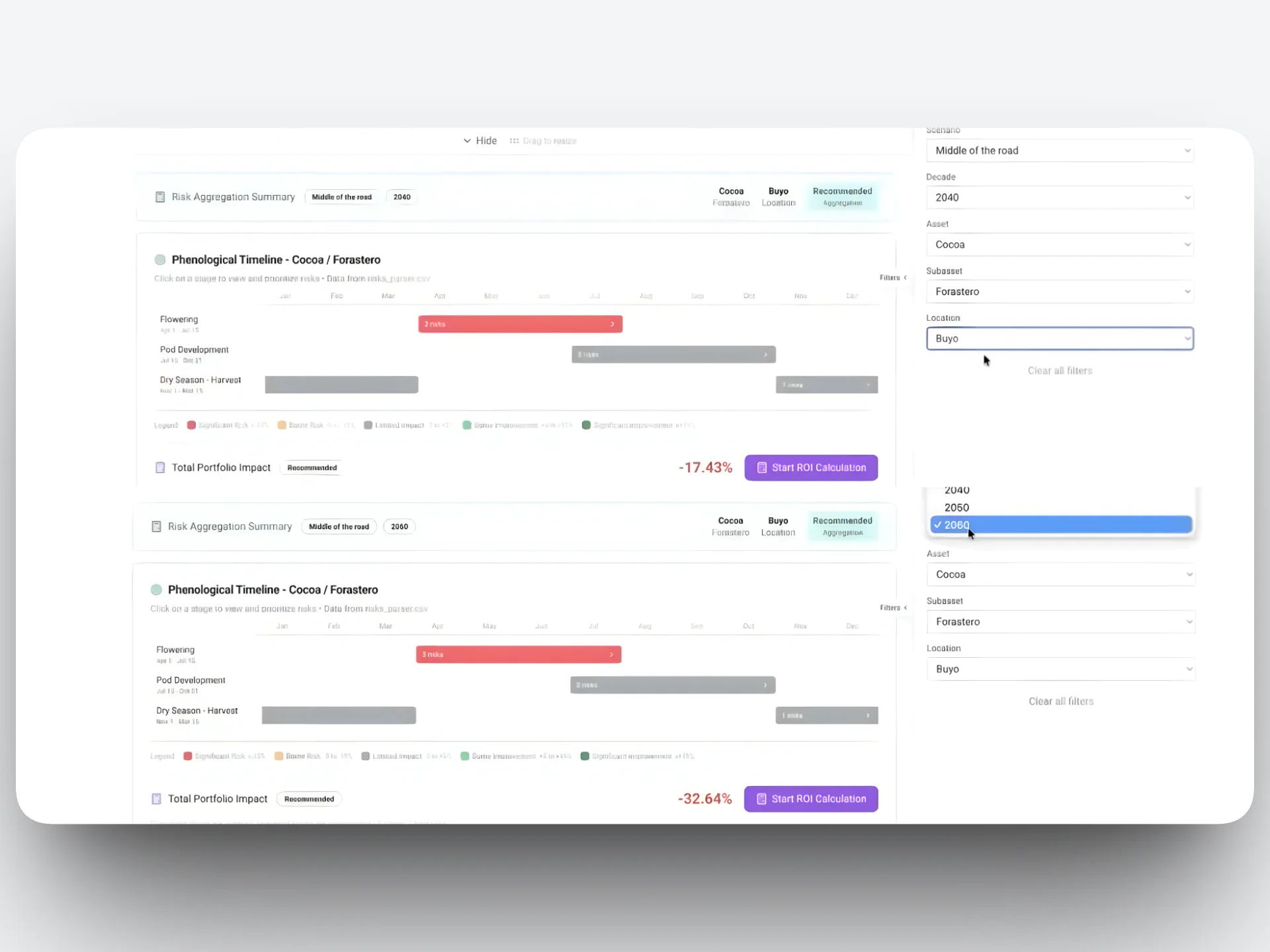
Firstly, once you know the crop and region you want to act on, we look at the risks and likely yield reductions the crop faces over different scenarios (middle of the road, worst case, etc.) and time scales (2040, 2050, 2060):
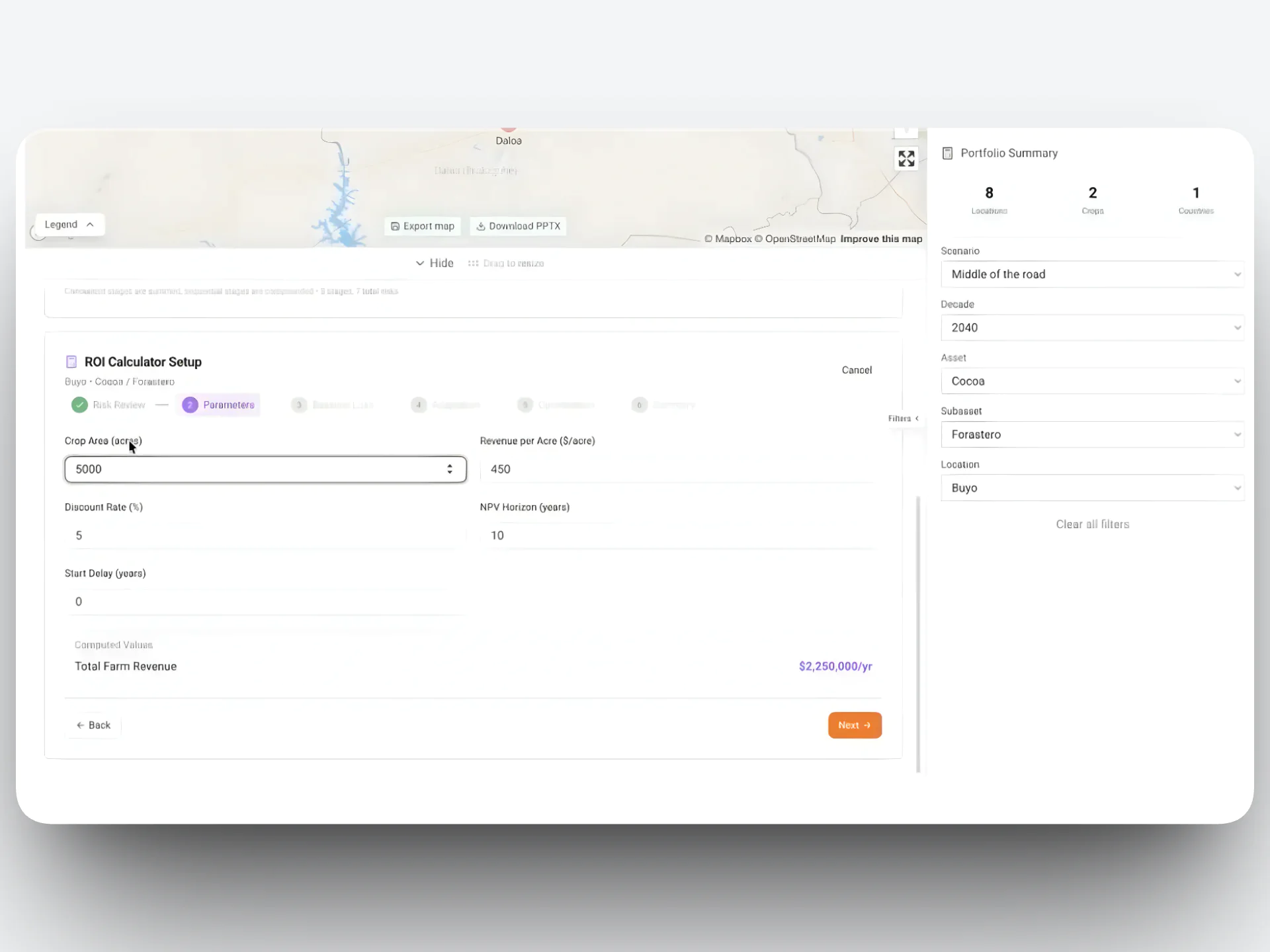
Then, to determine the ROI of different regenerative actions, you set up your parameters (e.g., the number of acres you have and the amount you earn per acre).
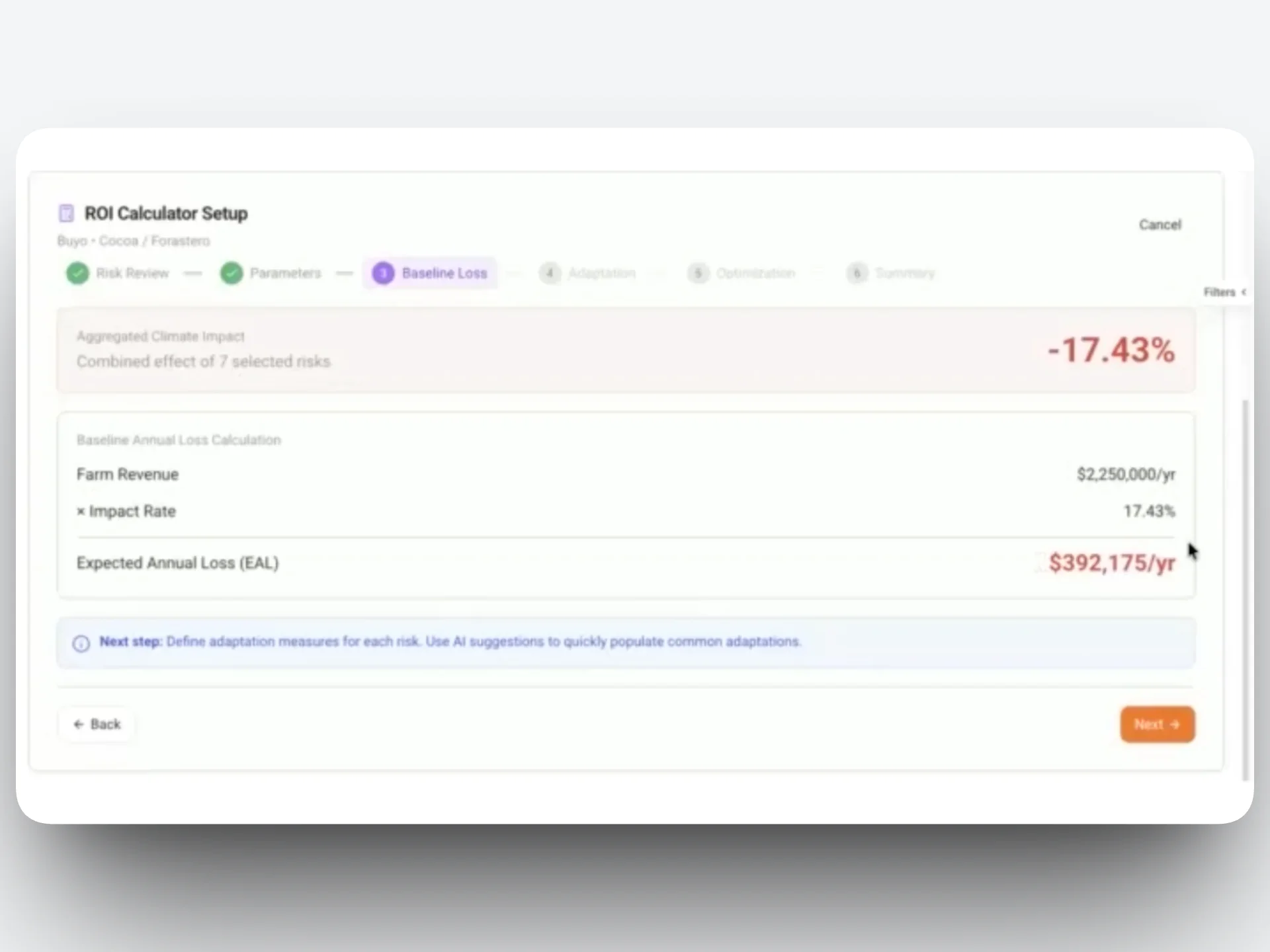
Once we have set the parameters of the calculation, we find an annual dollar amount impact on the expected yield loss over that time scale and scenario (in this case the annual expected loss amount in almost $400,000):
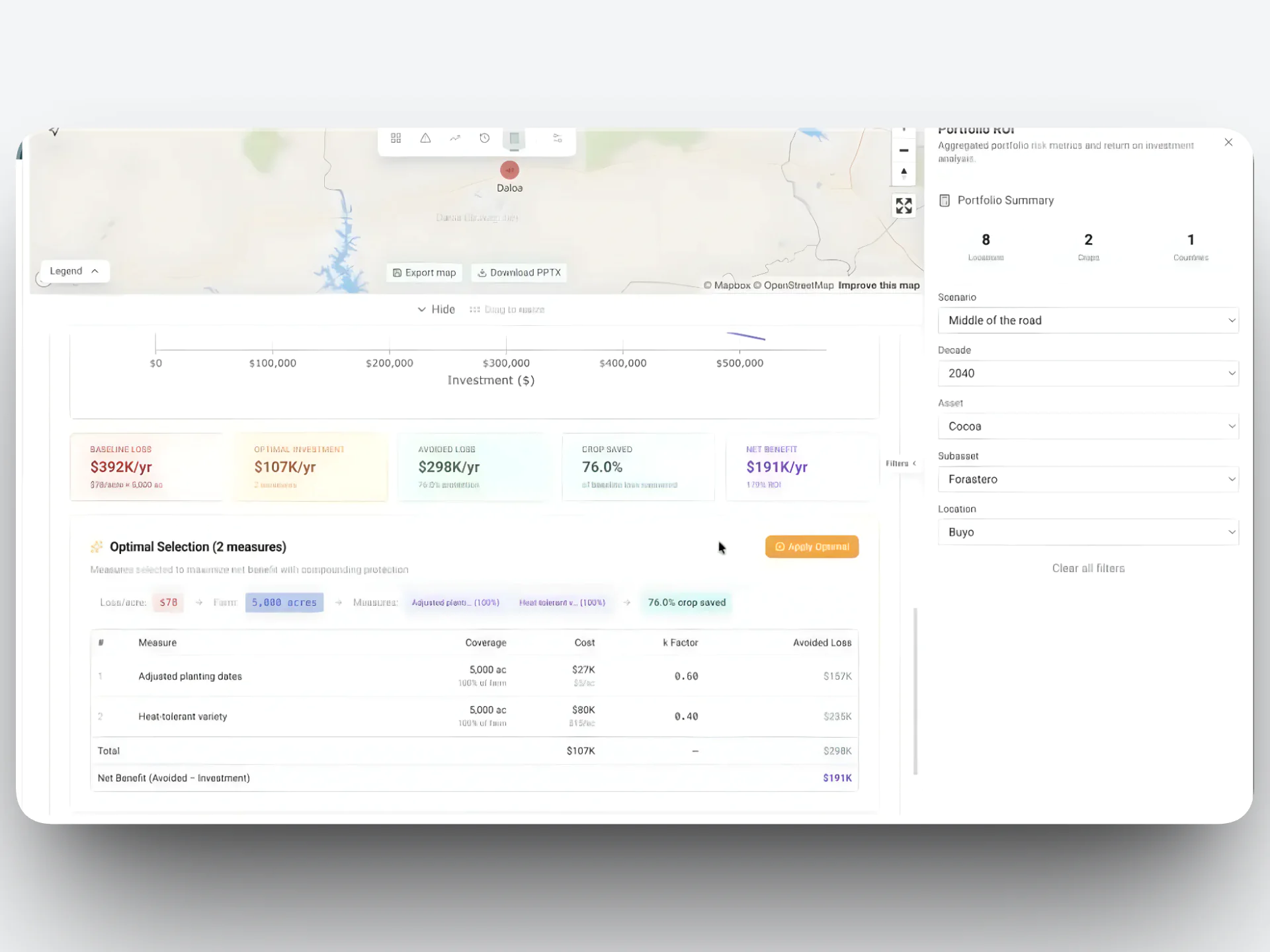
In the context of cocoa in the Ivory Coast, the only real weather impact on crops over the coming decades will be extreme heat, so that is the only area we need to consider regenerative agriculture practices.
To calculate ROI on each practice, you can either add your own custom regenerative practice if you are considering agroforestry or cover crops, for example. Alternatively, our AI adaptation agents can either provide input based on user operational assumptions or rely on AI Suggest, which provides baseline estimates for the cost and effectiveness of different bespoke adaptation strategies. In the example above, the two regenerative suggestions are changing planting timing and heat-tolerant varieties. It takes into account:
By modeling each of these interventions, Adaptation Agents can estimate: how much climate-related yield loss a regenerative practice can prevent.
The end result is a graph (shown below) showing the ROI timeline and optimal suggestions for the highest yield and best financial return.
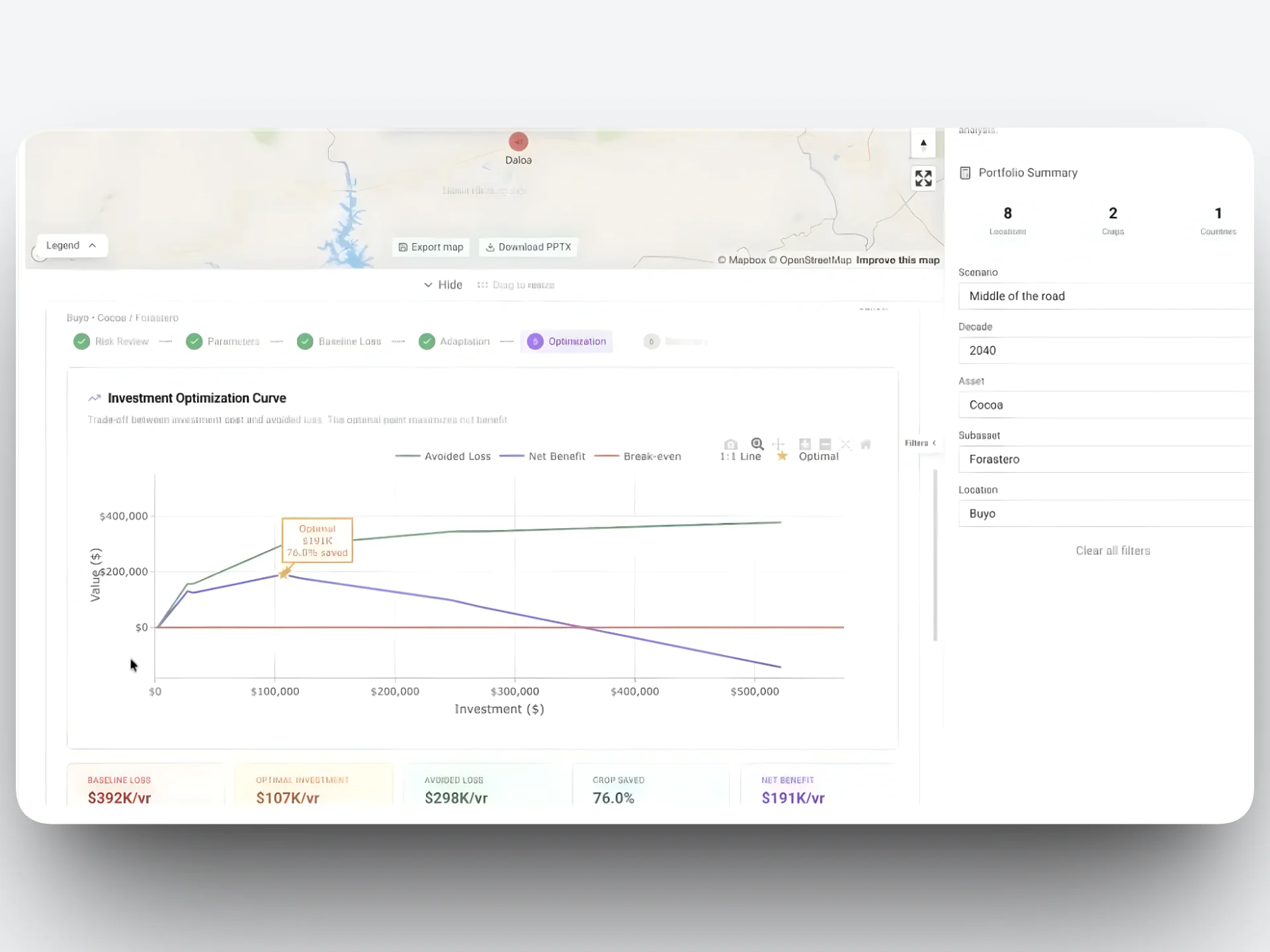
This transforms regenerative agriculture from a sustainability initiative into a measurable resilience investment. The tool shows you: here’s how much you could be impacted, here’s the loss you could expect in a given year. Then you can start modeling adaptations. In some cases, combining multiple strategies produces the strongest results.
Despite growing corporate commitments, many regenerative agriculture programs face similar structural challenges. These challenges often revolve around three core issues: time horizons, regional prioritization, and farmer adoption.
One of the biggest barriers to scaling regenerative agriculture is the time required for benefits to materialize.
Many regenerative practices, such as improving soil health, introducing cover crops, or transitioning to no-till systems, can take several years before delivering measurable improvements in yields or resilience.
Early deployments of ClimateAi’s Adaptation Agents suggest that the economics of regenerative agriculture are highly dependent on the time horizon. If your horizon is less than five years, it might not look attractive. But the longer the time horizon, the stronger the economics become.
This insight is particularly relevant for investors, asset managers, and companies managing long-term sourcing relationships. Organizations with 10–15 year investment horizons are often better positioned to capture the resilience and financial benefits of regenerative practices.
Another challenge is determining where regenerative agriculture will deliver the greatest impact. Climate risks vary significantly by geography. Some sourcing regions may face increasing exposure to hazards such as:
In these regions, regenerative practices may significantly improve soil resilience and reduce climate vulnerability. In others, the benefits may be more limited.
Climate intelligence allows companies to evaluate these differences and prioritize investments where regenerative agriculture can deliver the greatest resilience and investment gains.
Finally, farmer adoption remains a major barrier to scaling regenerative agriculture programs. Farmers often need clear guidance on:
By combining climate intelligence with agronomic insights and automated communication, companies can provide more targeted guidance to growers, helping farmers understand when regenerative practices are most likely to deliver benefits and clear instructions on how to do it.
This improves both farmer confidence and program adoption rates, allowing regenerative agriculture initiatives to scale more effectively.
As climate volatility increases, regenerative agriculture will play a critical role in improving agricultural resilience.
Adaptation Agents make the business case for regenerative agriculture by quantifying how regenerative practices reduce climate-related yield loss. Reach out for a demo to see the ROI of your regenerative practices.
The ROI of regenerative agriculture depends on factors such as crop type, region, climate risk, and time horizon. While short-term regenerative returns may be limited, long-term benefits often include reduced yield loss, improved resilience, and stronger financial performance.
ROI is difficult to measure because climate impacts vary by geography and evolve over time. Without climate intelligence, companies struggle to quantify how regenerative practices reduce yield loss or improve resilience under future conditions.
Adaptation Agents simulate how climate hazards affect crop yields and model how regenerative practices, such as changing planting timing or agroforestry, reduce those risks. They estimate avoided losses, costs, and net financial impact over time.
Practices such as cover cropping, no-till farming, agroforestry, soil amendments, and improved planting strategies can all be modeled to assess their impact on yield and resilience.
Climate risk determines how much value regenerative practices can deliver. In high-risk regions, such as those facing heat stress or drought, these practices can significantly reduce yield loss and improve long-term productivity.
Most regenerative practices require a long-term view. Investment horizons of 10–15 years typically provide a more accurate picture of financial returns and resilience benefits, but longer time horizons will show even greater returns.
Companies can use climate intelligence to identify regions with the highest climate risk and the greatest potential for reducing yield loss, allowing them to focus investments where impact and ROI are highest.

Andy Paterson is a content creator and strategist at ClimateAi. Before joining the team, he was a content leader at various climate and sustainability start-ups and enterprises.
Andy has held writing, content strategy, and editing roles at BCG, Persefoni, and Good.Lab. He has helped build one of the industry’s most popular newsletters and regularly publishes environmental science articles with Research Publishing.