
Andy Paterson • June 25th, 2026.
Strawberry farming is one of the most climate-sensitive specialty crops in agriculture. Unlike many grains and row crops, strawberries require narrow temperature, moisture, and harvest windows to maintain both yield and fruit quality.
Even a few days of extreme heat, heavy rainfall, hail, or frost can significantly affect yields. As a potentially powerful El Niño develops for 2026–27, growers and procurement teams face heightened risks across strawberry-producing regions.
While many of these risks affect blueberries, raspberries, and blackberries as well, strawberries provide one of the clearest examples of how climate change is reshaping berry production. Here’s how strawberry production and supply are impacted by climate risks and how to mitigate losses:
Strawberries are very temperature-sensitive. A study in Queensland, Australia, found that temperature increases of just 1-2°C can reduce strawberry yields by up to 28%. Extreme heat can also lead to
Extreme or unexpected rainfall events and flooding increase:
On the other hand, a lack of rainfall can also raise irrigation costs, or water constraints in regions can lead to yield and quality losses.
During a hail event, up to 80% of a berry crop can suffer cosmetic damage, which means the yield is ruined or has to be diverted from premium markets into juice processing channels
A late or early frost during critical crop phases, such as the flowering stage, can cause complete yield losses before the fruit even develops.
For strawberries, each of these risk quality losses can be just as damaging financially as outright yield losses.
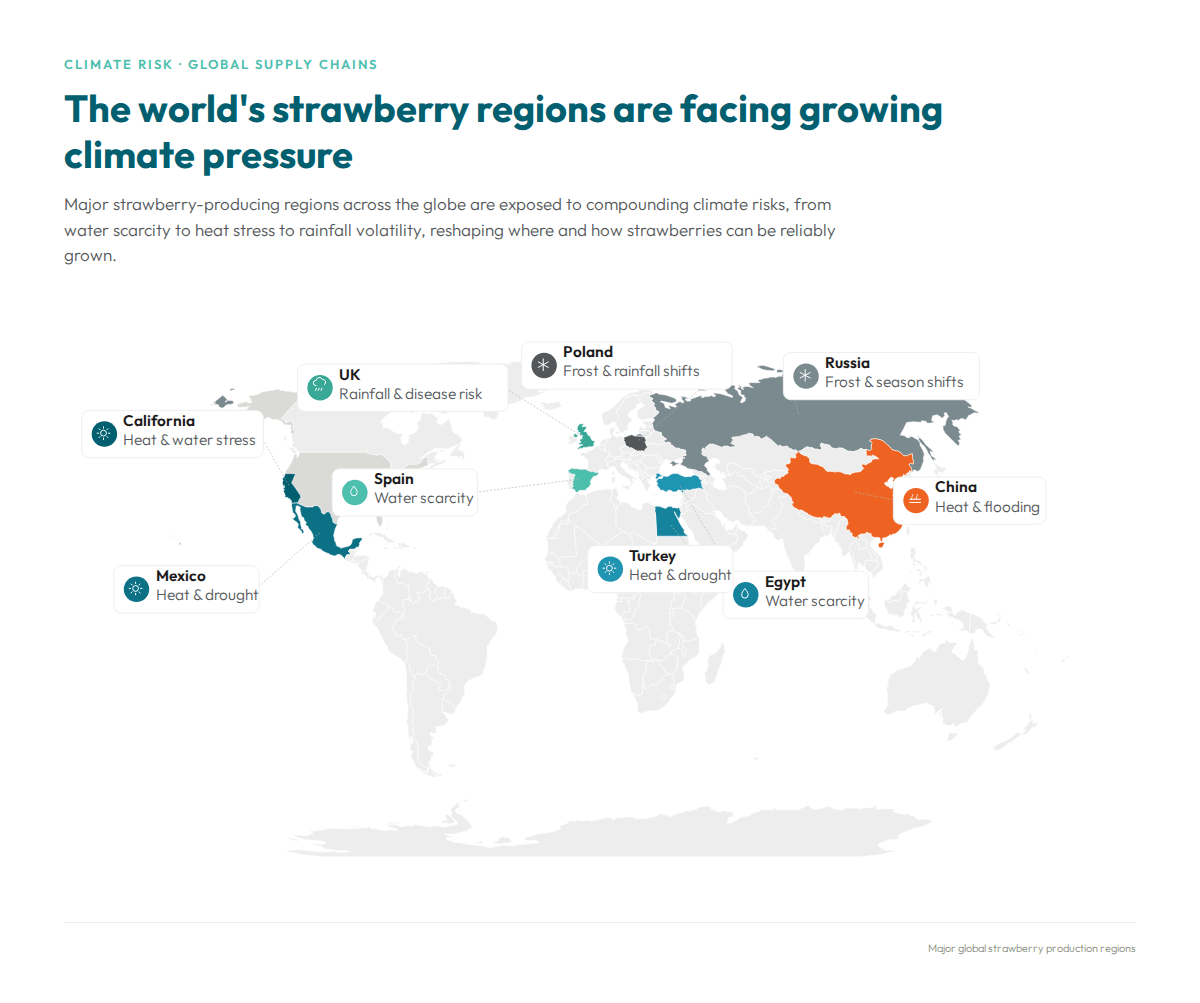
Every strawberry-growing region is impacted by accelerating climate risks. In regions like California, the probability of strawberry yield loss has increased significantly as the statewide average temperature has risen.
High-yield-loss events become highly likely when temperature anomalies exceed 1.7°C above normal, a threshold that is occurring with increasing frequency. In most other regions, it is the same. Major producers face increased heat, extreme rain, and water constraints.
Droughts do not always result in outright crop failures. More often, they reduce fruit size, increase quality variability, and lower marketable yields. This means growers may still harvest a crop, but a smaller percentage meets the standards required for premium fresh markets. The result can be a lower available supply, higher prices, and increased sourcing volatility for buyers.
In regions such as California, Spain, and Egypt, strawberry producers are already competing with municipalities, industry, and other agricultural sectors for limited water resources. As climate change increases the frequency of droughts and heatwaves, securing reliable access to water will be critical.
As a result, leading producers are investing in more efficient irrigation systems, drought-tolerant varieties, protected growing environments, and climate-intelligence tools that help identify emerging water risks before they affect production.
The El Niño Southern Oscillation (ENSO) is a cyclical warming and cooling of the central tropical Pacific that drives global weather patterns. It is characterized by droughts in SE Asia and southern Africa, wet winters along the Andes and the US Southwest, mild winters in Canada, weaker Atlantic hurricane seasons, and many more impacts.
This coming ENSO has a high probability of being a very strong Super El Niño, driving significant impacts in global weather patterns.
El Niño is associated with:
These impacts are felt differently in different regions of the world. However, the ENSO has historically impacted strawberry-growing regions. For example, 70% of El Niño seasons have above-average risk of the strawberry fungal infection Botrytis, requiring additional fungicide applications to mitigate losses.
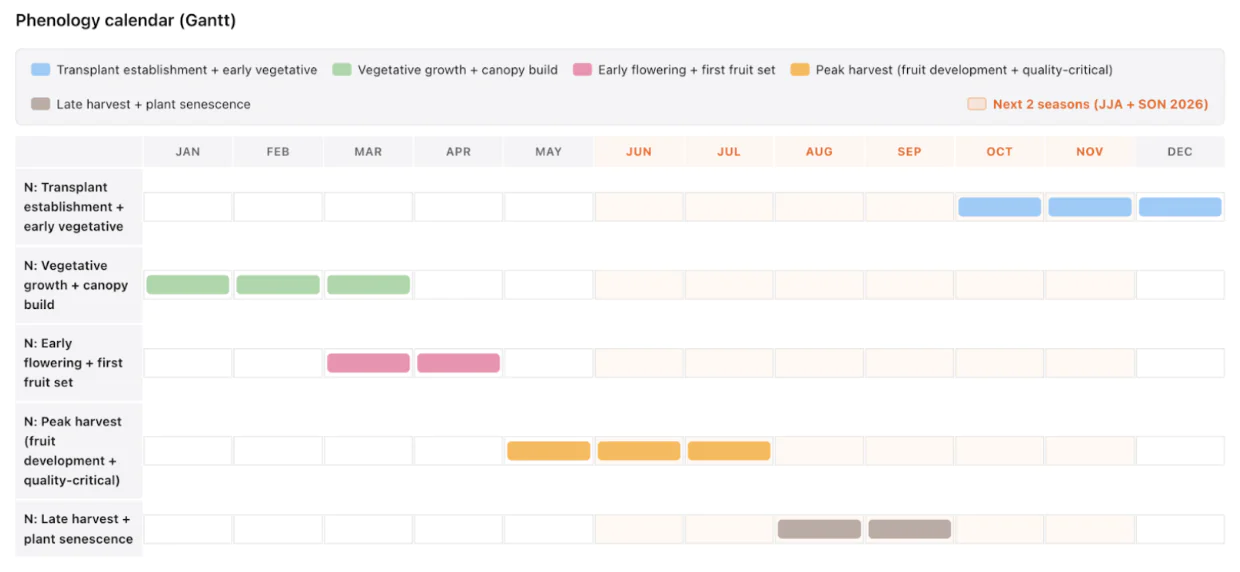
The upcoming ENSO coincides with critical growth periods for strawberries. Peaking during fruit development and early vegetative stages. For example, late-season heat in Aug–Sep 2026 is forecast to be 10-25% above climatology across coastal California, where 80% of US strawberries are grown.
👉 Want to learn more about the 2026 El Niño? Download our ENSO Insights report.
In our experience, most strawberry producers and procurement professionals rely on:
However, as the climate changes, producer experience and historical averages are no longer effective.
Plus, operational decisions, such as strawberry procurement, labor planning, and irrigation capital decisions, are made weeks and months in advance.
Some of the world’s largest and most advanced strawberry-producing or purchasing companies are adapting to a changing climate by:
Season to season, companies are reviewing the climate risks their strawberry farms face and evaluating other regions to ensure supply continuity and protect against price spikes.
Over the longer term, companies are identifying new regions that can grow the strawberries they need over the next 25-50 years and investing in those areas to ensure long-term resilience.
Conducting water risk assessments and locking in irrigation credits or investing in water infrastructure have become best practices, especially in water-constrained regions. Leaders are also investing in new drought-resistant varieties that require less water.
Using granular forecasts with longer lead times helps companies move from reactive sourcing, where its damge limitation and most impacts on yield and quality are locked in, and major procurement decisions have already been made. To predictive sourcing, where alternative sourcing can offset supply losses and increased prices, and companies can work with suppliers to adapt and reduce losses.
In 2026 and beyond, there are key steps every procurement manager should take to build a more resilient strawberry supply chain. They should:
Climate risks rarely affect every region equally. While one sourcing region may face drought, another may experience excessive rainfall or have favorable growing conditions.
By monitoring both short-term weather risks and long-term climate trends across sourcing regions, procurement teams can better understand vulnerabilities in their supply chain, diversify sourcing strategies, and identify future growing regions as climate conditions shift.
Many strawberry companies source from multiple regions throughout the year to maintain a consistent supply. However, climate change is increasing the likelihood that traditional growing regions experience simultaneous disruptions from heatwaves, droughts, flooding, or extreme rainfall.
Organizations that evaluate alternative sourcing regions before disruptions occur are better positioned to respond when production challenges emerge.
A forecast showing an 80% probability of extreme heat three months before harvest is often more valuable than a forecast showing a 99% probability three days before the event.
Long-range probabilistic forecasts give procurement teams time to adjust sourcing strategies, secure alternative suppliers, manage inventory, and prepare for potential disruptions before contracts and production plans are finalized.
Climate volatility is already reshaping strawberry farming around the world. Heat stress, water constraints, extreme weather, and shifting growing conditions are forcing strawberry farmers and buyers to rethink how they manage risk and plan for the future.
As a potentially powerful El Niño develops through 2026 and into 2027, organizations that can anticipate disruptions before they occur will be best positioned to protect supply, manage costs, and maintain product quality.
Learn how ClimateAi helps growers, food manufacturers, and procurement teams forecast climate risks months ahead with crop-specific intelligence, water-risk modeling, and long-range climate forecasts. Request a demo today.

Andy Paterson is a content creator and strategist at ClimateAi. Before joining the team, he was a content leader at various climate and sustainability start-ups and enterprises.
Andy has held writing, content strategy, and editing roles at BCG, Persefoni, and Good.Lab. He has helped build one of the industry’s most popular newsletters and regularly publishes environmental science articles with Research Publishing.