
ClimateLens 2.0 is Here → See what’s new
Andy Paterson • November 7th, 2025.
Pests and diseases are among the biggest threats to global food security and waste. Up to 40% of global crop production is already lost to pests and diseases, costing more than $200 billion annually.
Rising temperatures, higher CO₂ concentrations, and increasingly erratic rainfall are expected to intensify these challenges, making pest and disease pressures harder to predict. As a result, producers and buyers across the agricultural value chain face growing risks of yield losses, quality declines, and rising production costs.
Currently, pest and disease management tools are inaccurate and input-intensive, resulting in substantial labor and remediation costs. AI-driven pest and disease models can be integrated into pest management systems to enable early diagnosis, better decision-making, and more effective outbreak management. Here’s how.
Climate is one of the most determining factors for the spread and propagation of pests and diseases. Climate change will therefore make management decisions more complex, impacting pests and diseases in the following ways:
These changes mean that what worked before in pest and disease control won’t work anymore, underscoring the need for an automated early diagnosis system.
Early diagnosis of pests and diseases is complex, and once favorable climatic conditions are present, outbreaks can spread rapidly. This means there is a small window of time for remediation, leaving the risk of yield loss and poorly timed applications high.
Most pest and disease management still relies on regular field scouting or solely on weather forecasts that don’t tell the full story. Under the changing conditions of climate change, these already ineffective pest and disease management systems are becoming more complex, with changing seasons, more erratic precipitation and temperatures, and regions experiencing some pests and diseases for the first time.
This means remediation measures are more reactive than predictive. More reactive pest management can lead to the misapplication of pesticides, fungicides, or herbicides. This results in millions of dollars in lost yields or reapplication costs, as well as more disease-resistant pests and diseases, and soil and ecosystem degradation.
For more effective integrated pest management systems, companies want earlier warnings so they can act well before an outbreak causes substantial damage. That means understanding when and where conditions become conducive to infestation or disease spread.
AI-driven pest and disease early diagnosis enables companies to access accurate weather data that tracks pest and disease conditions specific to each crop, phenological stage, and site. When a certain threshold is met, it can automatically alert producers and suggest remediation best practices.
Here is how AI pest and disease modeling helps mitigate losses:
AI weather models are validated across multiple crops and regions through hindcasting to demonstrate their performance against historical weather data and benchmarks. This helps producers know that the weather data they base their pest and disease management decisions on can be trusted.

A growing degree day (GDD) is a unit of heat measurement used to estimate plant phenological stages and the best times to plant and harvest. It is also a great way to predict the likelihood of pests. Helping determine when specific pests are likely to emerge based on accumulated heat over time. This makes accurate GDD tracking a critical tool for planning pest control strategies and ensures management plans are aligned with field conditions for optimized input timing.
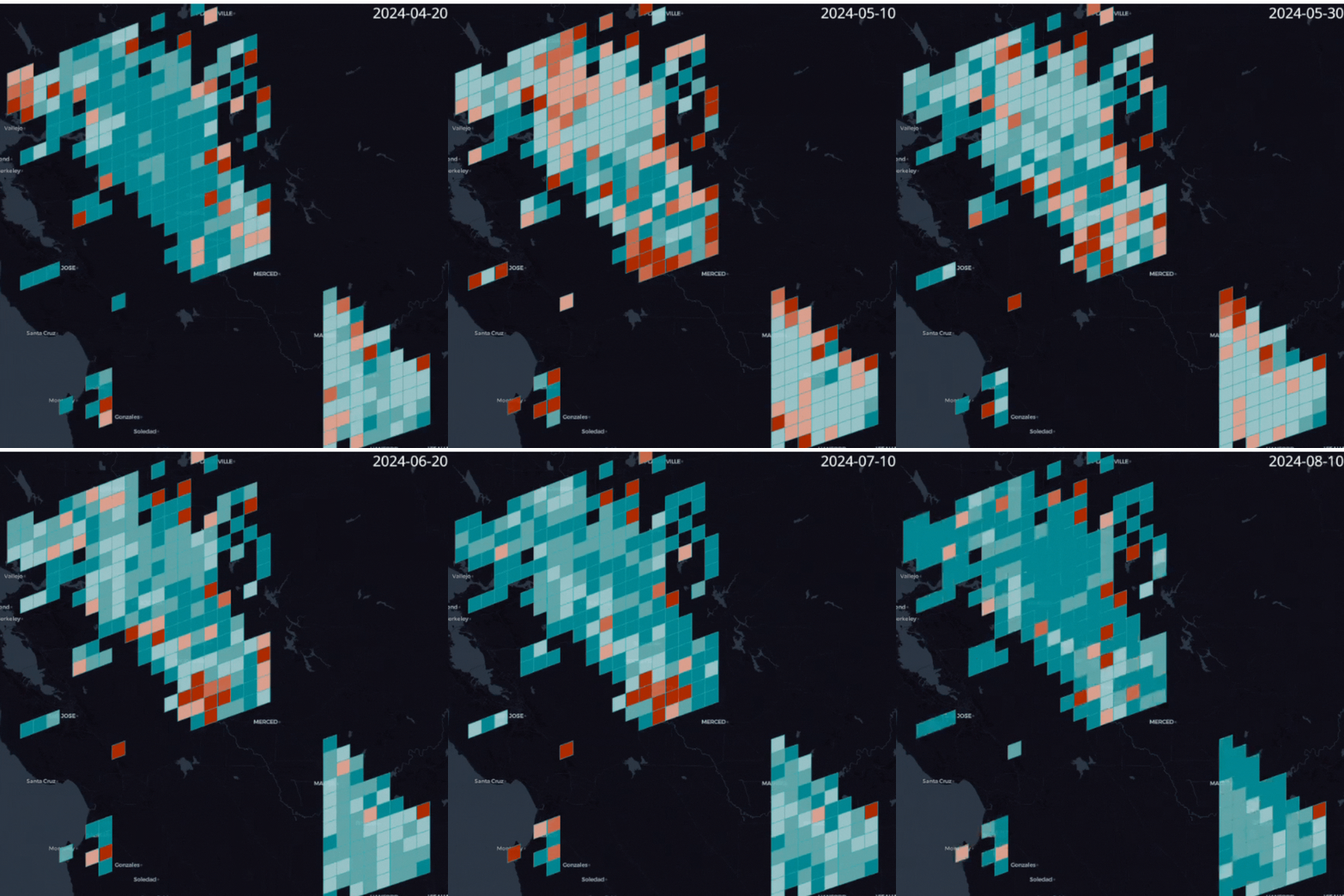
ClimateAi already provides our clients with alerts for specific climate conditions (e.g., humidity >75% and max temp >30 °C for 5 consecutive days) that could allow pests and diseases to thrive. We track this over both the short term, with our Monitor tool, and the long term with our Adapt tool, which are already helping customers make management or control decisions for pests and diseases, or compare which locations might face higher or lower pressure over time.
Now, we are in the pilot phase of developing the next iteration of pest and disease early-diagnosis tools, combining passive satellite observations with weather-based modeling to create a more precise, automated system. Unlike traditional solutions that rely on weather data and manual field measurements, ClimateAi leverages individual satellite captures to detect subtle changes in vegetative health that indicate the early onset of disease or pest stress. These passive measurements are harmonized with weather data through our upcoming pest and disease GDD (growing degree day) tool, enabling us to continuously assess risk conditions without requiring on-site inputs.
We validate these detections using up to five environmental variables — such as temperature, humidity, and wind speed — to determine whether the optimal conditions for pest, fungal, and pathogen growth are met. This creates a closed-loop system that forecasts when risk emerges, confirms when outbreaks begin, and gives users the confidence that their actions will save yields and optimize inputs, all while reducing labor and input costs through targeted, data-driven scouting and remediation.
The costs associated with losing more yield to pests and diseases each year, and with mis-timed application of remediation solutions (fungicide, herbicide, etc.), are mounting under a changing climate. This means more accurate early diagnoses of pests and diseases, and effective management systems will deliver a considerable ROI.
By providing early, accurate, trusted alerts and remediation recommendations, producers can improve yields, operational planning, and reduce input costs. Agricultural buyers, especially those managing large supplier networks of small-scale farms, can strengthen supply chain resilience by sharing any of this information with their suppliers.
Pests and diseases thrive under certain climate conditions. Accurate information about how those weather conditions are evolving for specific pests, locations, crops, and phenological stages represents a step change in agricultural adaptation.
For producers and food buyers, this means fewer surprises, more efficient resource use, and stronger supply resilience for every crop and in every region.
By fusing accurate weather forecasting, remote sensing, and AI data interpretation, ClimateAi helps companies see risk before it happens. To see how our pest and disease early diagnosis tool can enable better decision-making and transform reactive responses into proactive ones
👉 Book a demo.

Andy Paterson is a content creator and strategist at ClimateAi. Before joining the team, he was a content leader at various climate and sustainability start-ups and enterprises.
Andy has held writing, content strategy, and editing roles at BCG, Persefoni, and Good.Lab. He has helped build one of the industry’s most popular newsletters and regularly publishes environmental science articles with Research Publishing.