
Alex Luna • July 17th, 2026.
Physical climate risks are becoming more severe and frequent. While floods have taken much of the adaptation funding and focus, wildfires are spreading into regions with little or no historical precedent, bringing them up the priority list for businesses.
Wildfires are becoming more frequent and severe in fire-prone areas and are moving into places with no historical baseline. This means backward-looking models are becoming less relevant in wildfire management and adaptation.
There are many tools that detect fire once it has started, but almost none anticipate it. In this article, we will show how climate change is reshaping wildfire risks and how wildfire risk modeling can support early detection by identifying conditions conducive to wildfire well before ignition.
Physical climate risks are the direct impacts climate change has on assets, operations, and supply chains. They include impacts, such as:
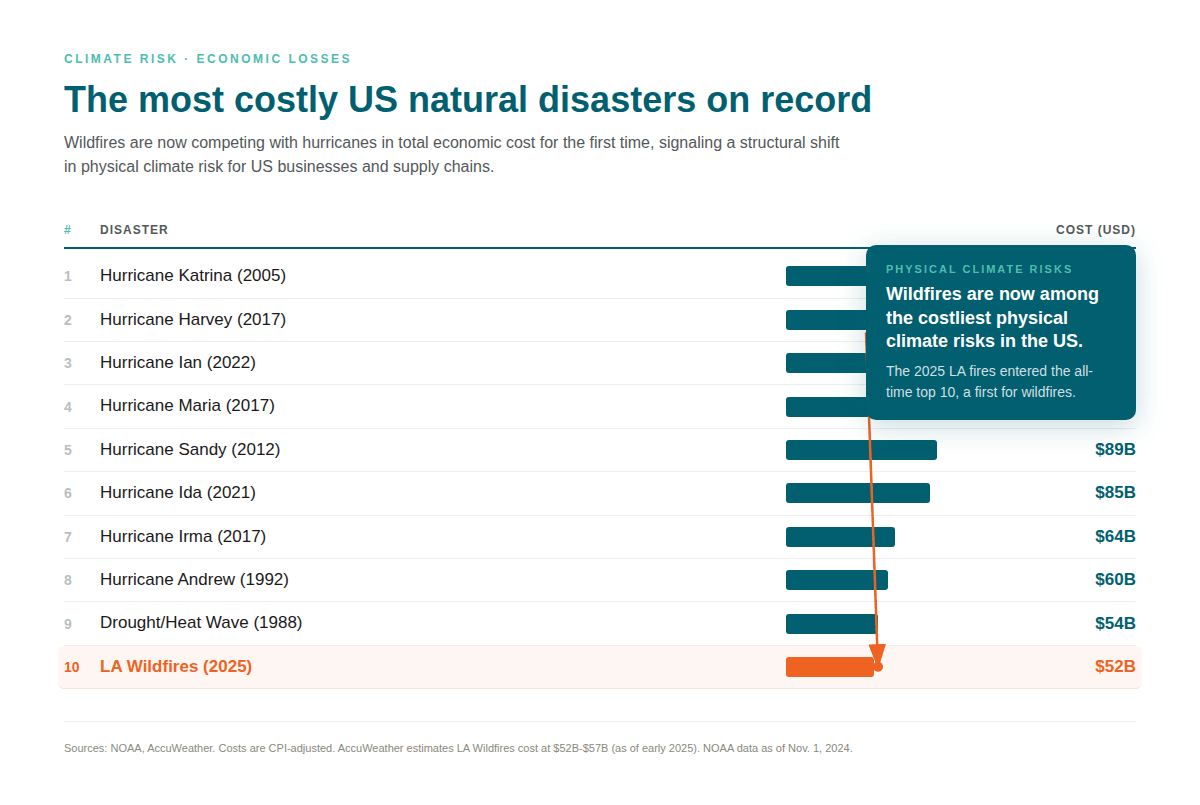
Wildfires are increasingly having a major impact on both businesses and populations, with individual events becoming more costly to suppress and burning larger areas. Areas with historically high wildfire risk see more intense events, like the LA fires in 2025, which were the 10th most costly natural disaster in US history.
With longer dry seasons, higher average temperatures, and more heatwaves, wildfire conditions have also expanded beyond regions that have historically experienced them.
Companies from finance to agriculture that rely on historical data to assess their wildfire physical climate risks can no longer rely on these historical wildfire maps to assess future exposure.
Fires are appearing outside historical zones, and current wildfire risk assessments only answer questions like: “Where have fires happened before?” or “Where is a fire happening right now?”
While answers to these questions are valuable, neither answers the question organizations increasingly need answered: “Are conditions becoming favorable for a wildfire to start?”
An answer to that question can help price insurance, shift supply routes, plan infrastructure, and protect assets proactively before a fire breaks out, rather than reactively.
Answering this question requires understanding changing environmental conditions weeks or months beforehand. Modern climate risk management must therefore move beyond historical maps toward predictive forecasting. An essential additional layer of wildfire intelligence.
One misconception about wildfire forecasting is that it attempts to predict the exact time and location of every fire. Instead, seasonal wildfire forecasting evaluates whether environmental conditions are becoming increasingly favorable for wildfire ignition and spread.
These forecasts combine information such as:
Physics-informed machine learning models integrate these variables to estimate the probability that landscapes become susceptible to wildfire over the coming months. Providing decision-makers with advanced probabilities enables more effective planning of resources and operations.
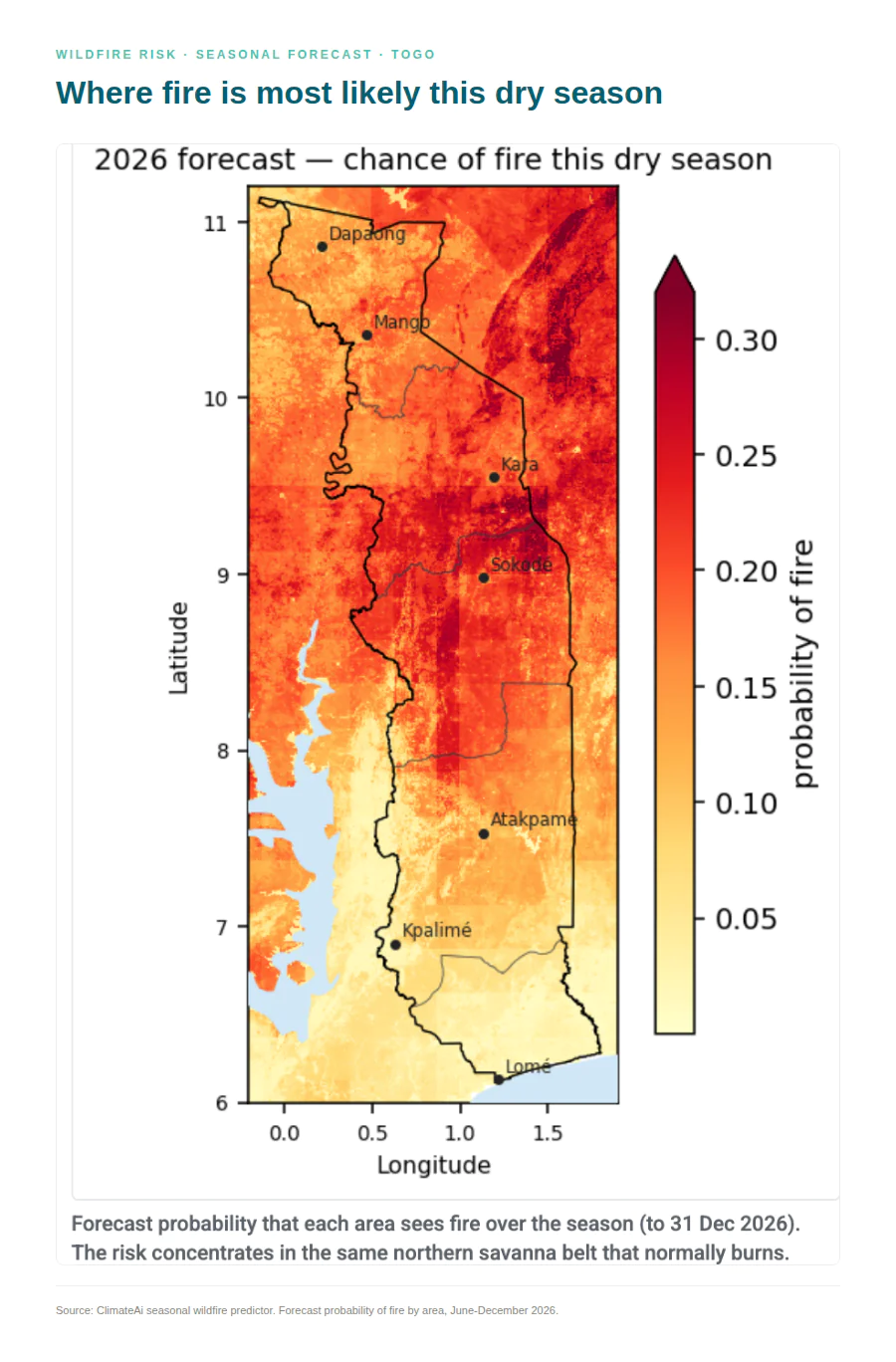
Northern Togo experiences seasonal wildfires every dry season, but the timing and severity vary considerably from year to year depending on weather patterns, vegetation, and fuel conditions. That makes it an ideal test case to demonstrate how seasonal wildfire forecasting can support decision-making.
ClimateAi used seasonal weather forecasts, satellite observations of vegetation and fuel conditions, and a physics-informed machine learning model in Togo to use as a use case. The forecast estimated where wildfire conditions were most likely to develop during the upcoming dry season.
The model identified Northern Togo as the highest-risk region, with wildfire probability increasing through November and peaking in December. These forecasts were then compared against more than a decade of historical wildfire observations from NASA FIRMS, showing strong agreement with where and when fires have typically occurred.
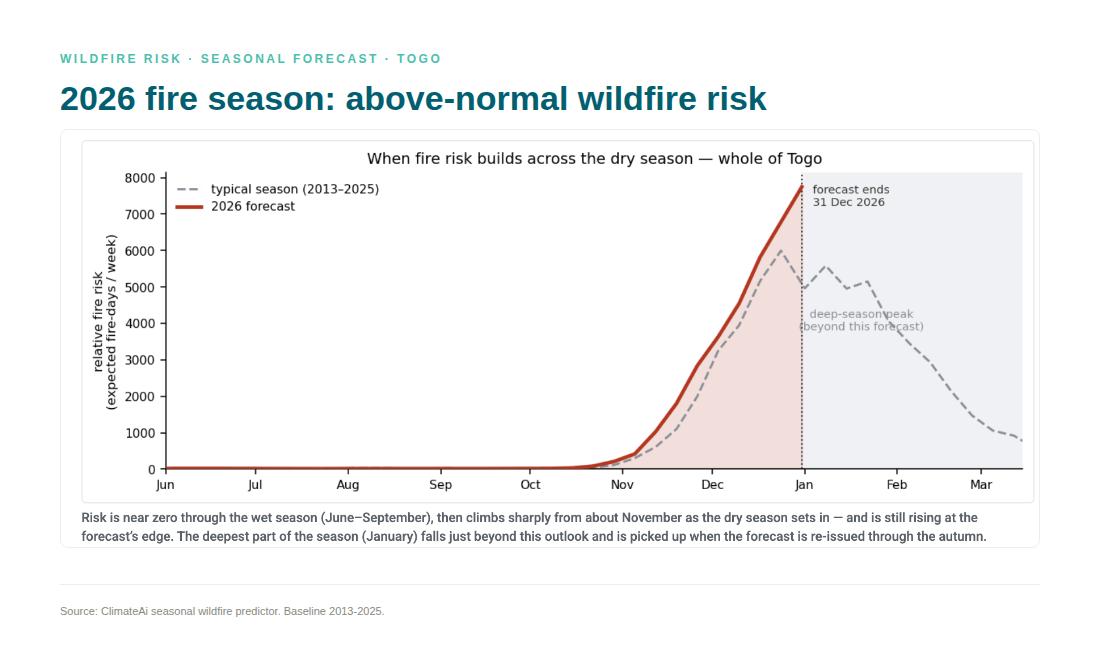
Importantly, the forecast is not designed to predict individual fires. Instead, it identifies where environmental conditions are becoming increasingly favorable for wildfire ignition and spread, giving organizations time to prepare before the fire season intensifies.
A seasonal wildfire outlook is valuable because it supports decision-making across sectors.
This Togo outlook is an early proof of concept developed by ClimateAi to demonstrate how seasonal wildfire forecasting can support proactive climate risk management. It estimates the probability of wildfire conditions by combining seasonal weather forecasts with satellite observations of vegetation and landscape conditions.
The forecast was validated against historical wildfire activity, but like all climate forecasts, it carries uncertainty. It is intended to guide where and when wildfire risk is most likely to concentrate, not to guarantee that a particular location will or will not burn, or to predict the exact timing of individual fires.
Wildfires rarely affect businesses in the same way. While you may think of burning forests or damaged buildings, many organizations experience disruption long before a fire reaches their assets or long after it has been extinguished.
For growers and food manufacturers, wildfire is often as much a supply chain problem as a production problem.
Smoke can delay harvesting even when crops remain undamaged, while poor air quality and road closures can prevent workers from reaching fields. Food processors may lose access to suppliers as transportation routes are disrupted, and prolonged heat and dry conditions can reduce crop quality before a wildfire even starts.
Wildfires are increasingly appearing in regions with little historical precedent, making traditional risk models less reliable.
Insurers and financial institutions need forward-looking climate intelligence to improve underwriting, assess risk exposure in their portfolios, and track how wildfire risk is evolving as climate patterns change, rather than relying solely on historical claims data.
Power infrastructure is both vulnerable to wildfire and, in some cases, a potential ignition source. Utilities need to understand when environmental conditions create elevated fire risk so they can increase inspections, deploy crews, or consider preventative measures such as targeted power shutoffs or vegetation management in high-risk corridors.
Public agencies must decide where to position firefighting resources, when to increase public awareness campaigns, and how to prioritize prevention efforts. Seasonal wildfire forecasts provide additional time to prepare communities and implement preventive measures before conditions become critical, rather than responding only after fires have already ignited.
Burned vegetation reduces the landscape’s ability to absorb rainfall, increasing runoff and the risk of flash flooding. Supply chains can remain disrupted for weeks or months, while infrastructure repairs, insurance claims, and recovery efforts continue long after the immediate emergency has passed.
Wildfire has become a cascading physical climate risk, one that affects operations, supply chains, infrastructure, and financial performance throughout the entire event lifecycle. Earlier, more actionable intelligence allows businesses to make better decisions before any disruptions.
Seasonal wildfire forecasts are valuable because they inform action before any losses. Instead of reacting after ignition, organizations can begin preparing months in advance.
That may include:
This represents a broader shift in climate risk management, enabling organizations to increasingly use climate intelligence to support operational decisions months in advance, rather than reacting after the opportunity has passed.
Historical climate records will always remain important. But in a changing climate, they are no longer enough on their own. Organizations need to understand not just where risks have existed, but where conditions are creating new risks before disruption begins.
The companies that build this predictive capability today will make better operational, financial, and supply chain decisions under an increasingly uncertain climate.
The future of wildfire management is anticipating where climate conditions are creating tomorrow’s risk. As physical climate risks continue to evolve, organizations that combine historical knowledge with predictive climate intelligence will be better positioned to protect their people, assets, and supply chains long before ignition.
👉Request a full wildfire outlook.